

Will Next-Generation Artificial Intelligence Robots be Powered by Fusion Energy?
For 99 years (at least in film), sentient robots have dominated our imagination, science fiction, and now our science.

In a very real sense, fusion energy bridges the distance between science fiction and actual science - a clean and nearly unlimited power source at our fingertips, powering from sentient beings to cities to spacecraft, and everything in between. Another thing that bridges the gap between science fiction and actual science, especially today, are AI-powered robots or in the future perhaps sentient robots. Please join us at The Fusion Report as we investigate the merger of these two subjects, and look at the likelihood that fusion power will power next generation robots and sentient beings.

From Metropolis to Star Wars: Robots in Literature and Film
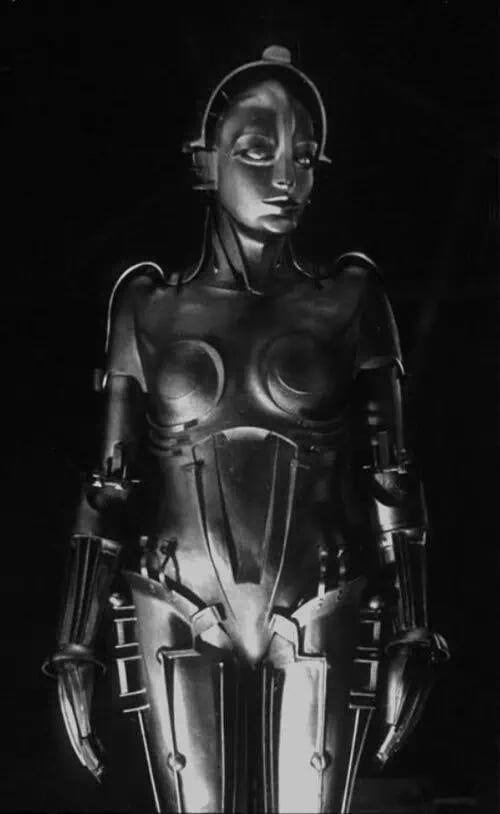
While the concept of artificial humans and autonomous servants has been around since well over 2,000 years (including golems and Mary Shelley’s Frankenstein monster), the actual term robot was first used in 1920 in Karl Capek’s play “R.U.R.”, where the robots are artificially manufactured from organic materials to labor for humans, and which eventually revolt and overthrow their human creators. The first time that robots appeared in film was in Fritz Lang’s 1927 masterpiece film “Metropolis”, where the mad scientist Rotwang built a robot to replace his lost love ‘Hel’. We would have to wait again till the 1950s when GORT emerged in “The Day the Earth Stood Still” (reprised in 2008) as a race of alien robots. From then on, robots became commonplace; arguably the best-known robots were R2-D2 and C-3PO from Star Wars, though other films and literary works made wide use of robots as well.
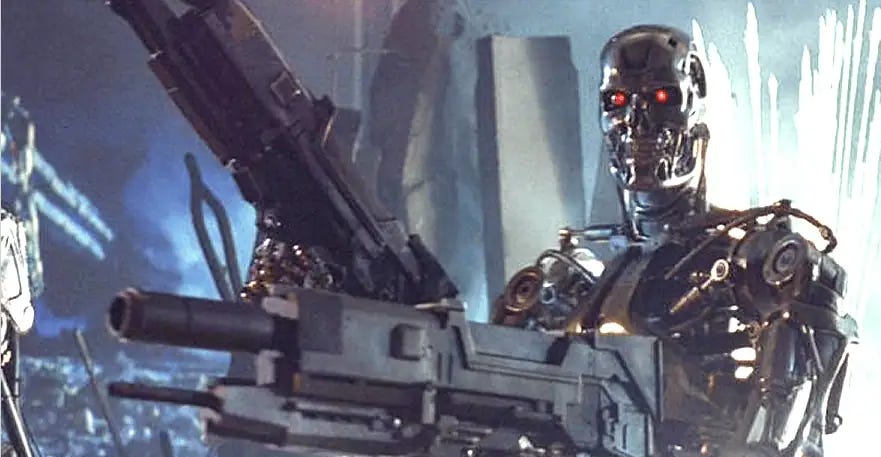
But when fusion, nuclear power, artificial intelligence and robots joined together in the 1984 movie “The Terminator” that thing’s got nasty. In that movie, an artificial intelligence called Skynet, a band of nuclear-powered robots called Terminators set out to destroy the human race. The theme was re-imagined (in a sense), with the 1999 movie “The Matrix”, where an AI created a digital simulation, where humans were kept as unknowing captives, and their bioenergy (“along with a form of fusion”) was used to power the AI. Aptly enough, the place where the humans were kept to harvest their energy was known as “The Power Plant”.
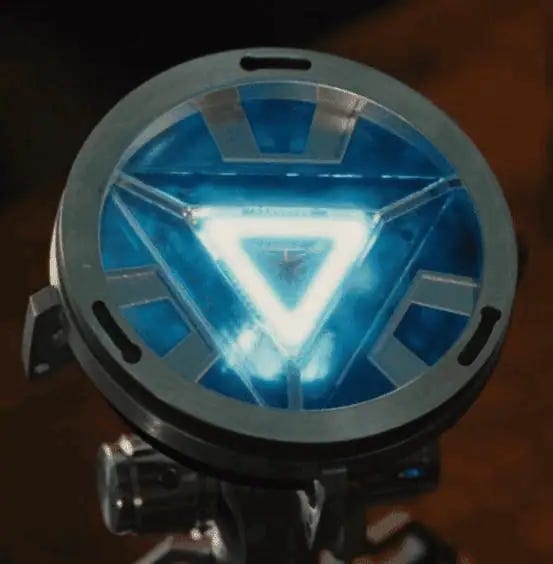
With the new millennium, movies regarding robots and AI have taken a new twist. Perhaps the most ambitious was 2008’s Iron Man, where Tony Stark, played by Robert Downey Jr., created a miniature chest piece that was actually a fusion reactor (called an Arc Reactor in “Iron Man” parlance), which powered both his own armor suit and those of his cohorts like Vision. The device was based on a device invented by Tony’s father Howard Stark; while potentially challenging from an engineering standpoint, the miniature Arc Reactor seems more potentially realistic than Tony’s flying armor suit 😊.
Somewhat more plausible were the later Terminator movies “Terminator: Salvation” and “Terminator: Dark Fate”, where the robots (and a human “augment” in Terminator: Dark Fate) were powered by nuclear power cells, powered either by hydrogen or iridium. Nuclear power cells are not nuclear reactors like Three Mile Island or Chernobyl nuclear power plants; rather they are “atomic batteries” that use energy from the decay of a radioactive isotope to generate electricity. Ironically, these are real devices which have powered numerous satellites, though none are capable today of the power output shown in the Terminator movies.

The Physics of Powering Robots With Fusion Devices
Which brings us to a discussion of how likely it is that robots could be powered by a fusion device. We will dispense with the scenario where the AI robots are powered by batteries, and simply hooked to a grid powered by fusion power plants. Obviously we have fission power plants today, and fusion power plants are (hopefully) not too far away.
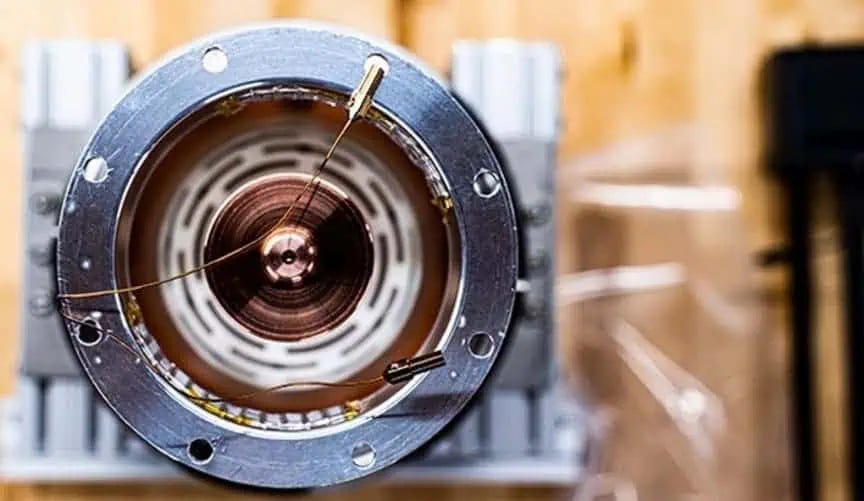
As far as fusion devices go, a number of them have been proposed with fairly small size. While they are not quite as minute as Tony Stark’s miniature Arc Reactor, they are small enough to be potentially used to power a robot in the not too distant future. An example is Avalanche Energy’s latest device known as the Orbitron, which utilizes electrostatic fields and magnetron to trap fusion ions, and it’s plasma chamber is roughly the size of a fire extinguisher (about six inches in diameter). Though it is only in development today, and has not reached Q>1 (generating more power than they consume), it has a target power output of up to 100kWe. That is comparable to the power output of a modest electric vehicle such as a Chevy Bolt or Nissan Leaf, which would be more than adequate for an AI robot.
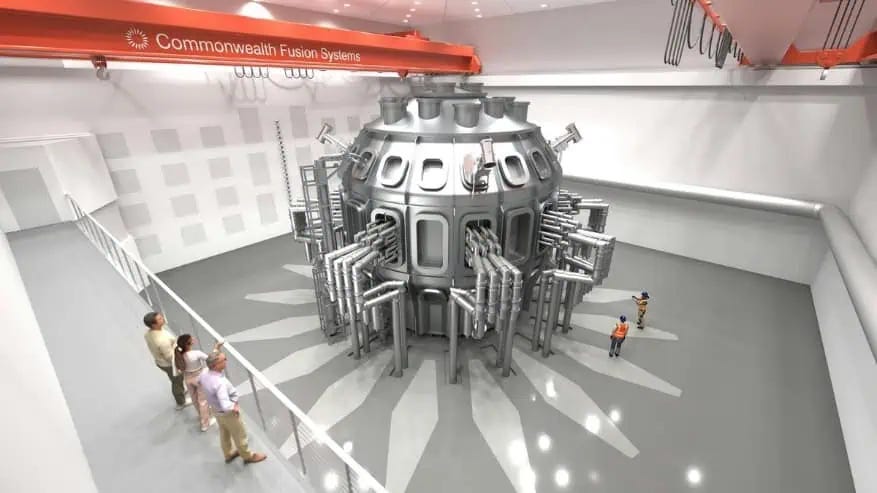
Similarly, a number of devices in the 1.5 to 2 meter range have been proposed by a number of university labs and companies. The Commonwealth Fusion Systems (CFS) SPARC fusion machine has a major radius of 1.85 meters, with a peak fusion power output expected to be 140 MWe when completed before the end of the decade. Though it is not small enough to fit inside a humanoid robot and SPARC is not a production machine capable of producing electricity (the follow-on ARC fusion machine is, however), it could produce enough energy to power a significant AI machine if it was so equipped.
Conclusion: AI-Powered Fusion Robots – Not Yet…
Assuming commercial energy fusion happens soon (which we all hope it does), the real issue of powering AI powered robots with fusion is not a power output question; it is a size issue. Even the smallest prototype fusion machines today are nearly desktop in size, when considering all the required supporting equipment. And unfortunately, the material that changes the fusion energy from heat to electricity is still a turbo-generator, which are big and heavy. Perhaps with Helion’s approach there are some better options for turning fusion energy into electricity, Their current fusion machine is 19 meters long, which is a bit on the large side for a humanoid robot. Nonetheless, I doubt that people would consider fusion energy a failure if it was able to support electricity generation, but was unable to power humanoid-sized robots directly – even the Terminator or the Matrix did not go that far 😊.