

Multiple Progress Announcements from Realta Fusion/Kyoto Fusioneering and Helical Fusion Today
A hot day (pun intended) in the fusion energy market.

Today, The Fusion Report is covering two big pieces of news in fusion energy: the announcement of a partnership between Realta Fusion and Kyoto Fusioneering of Japan (we also have an interview with Realta), and the announcement of Helical Fusion's construction site for their Helix HARUKA integrated demonstration device at the Japan National Institute for Fusion Sciences (NIFS) campus. We will cover each below and explore their impact. Let’s start with the Helical announcement, then pick up the Realta Fusion/Kyoto Fusioneering partnership and the Realta interview.

Helical Fusion Announces Their Helix Haruka Site
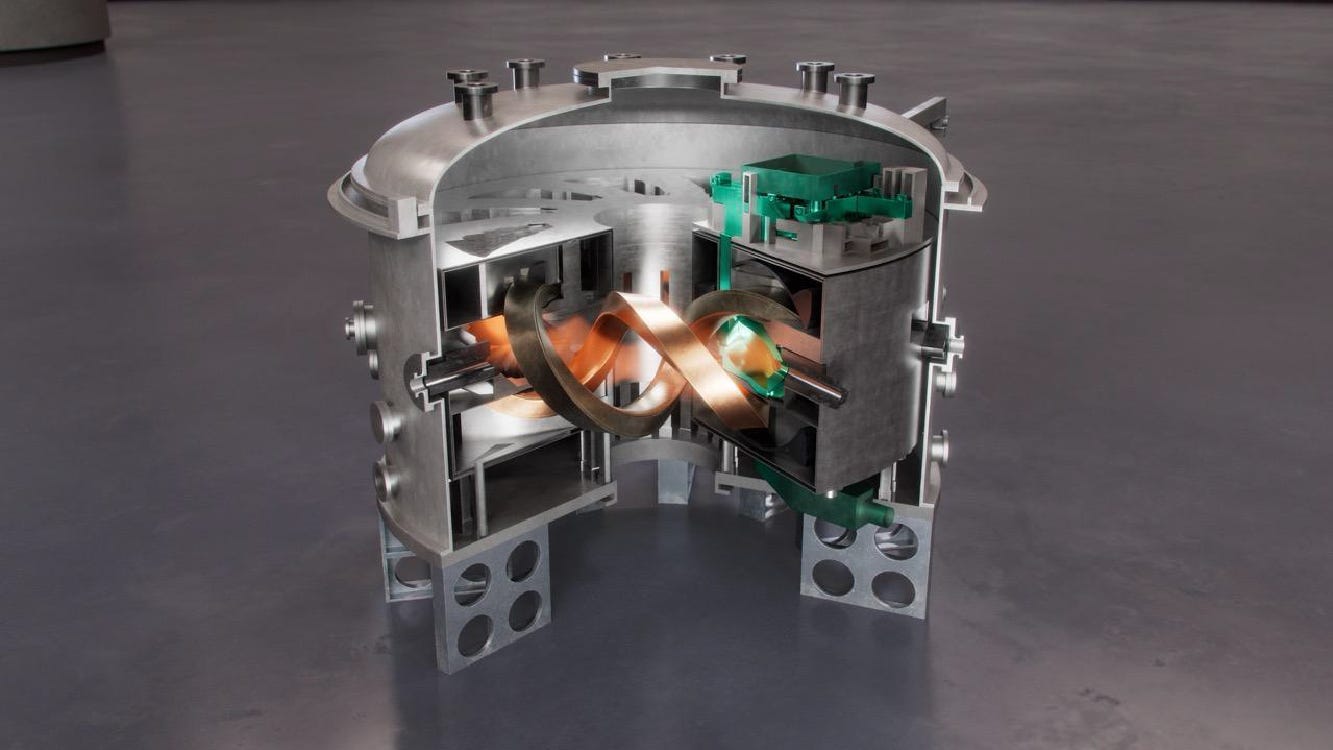
Conceptual Drawing of Helical Fusion’s Helix HARUKA Device
Today, Helical Fusion Co., Ltd. announced the construction site for Phase 1 of Helix HARUKA, its fusion integrated demonstration device. Phase 1 of the program (the Magnetic Demonstration Phase) will be built in a dedicated workspace at the Japan National Institute for Fusion Science (NIFS), also home to the Large Helical Device (LHD), a world-class fusion plasma research facility in Toki, Gifu, Japan. This is the first part of a three-part program that will culminate in building the Helix Kanata, the first power generating unit by Helical Fusion. The arrangement is a representative example of Japan’s public–private partnership model for fusion development, combining a national research institute’s infrastructure with industry-led engineering and manufacturing.
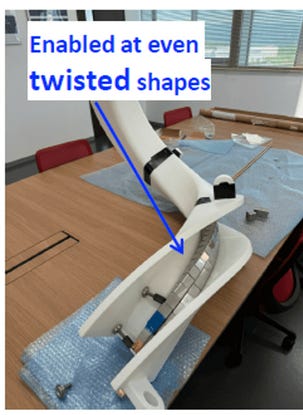
For those who are regular readers of The Fusion Report, you will remember that we have highlighted Helical Fusion in several recent stories. In December 2025, we covered Helical’s Series A extension funding raise of $5.5M, as well as signing their first Fusion Power Purchase Agreement with Aoki Super Co., Ltd., a regional Japan supermarket chain headquartered in Nagoya, Japan. Two months earlier, we covered their achievement of a milestone 7-Tesla Magnetic field strength utilizing their high-temperature superconductor (HTS) magnets. The magnets use Helical Fusion’s proprietary HTS cable architecture, rather than tape-based conductors, enabling the complex 3D winding geometries required for a Helical Stellarator, while improving manufacturability for large-scale coils.
NIFS is the leading public research institution in Japan that is pursuing helical stellarator research. The institution has operated the LHD, one of the most advanced stellarator devices, since the commencement of experiments in 1998, and completed its experimental campaign on LHD in December 2025. Through the LHD, NIFS has accumulated significant know-how for long-duration plasma operation, including sustaining plasma for 3,268 seconds (54 minutes 28 seconds). Building on these results, NIFS has also developed engineering and design-optimization expertise for stellarators, including advances in plasma stability control and the management of heat and particle loads. Helical Fusion, founded in 2021 as a spin-out of NIFS, has operated under a research agreement focusing on key technologies for fusion machines such as HTS magnet systems, thermal blankets, and divertor systems.
The focus of Helical Fusion’s Phase I of Helix HARUKA efforts will be high-current testing of a non-planar helical HTS magnet system. The Phase 2 of Helix HARUKA. efforts will focus on an integrated demonstration of the core subsystems for helical stellarators, including a complete assembly of HTS magnets and the thermal blanket/divertor systems. Finally Helical Fusion’s Helix KANATA will focus on the operational testing of their production prototype. These will include operational testing criteria which include the achievement of net electrical generation, power operation, state-state operation, and maintainability demonstrations.
Realta Fusion/Kyoto Fusioneering Partnership Announced
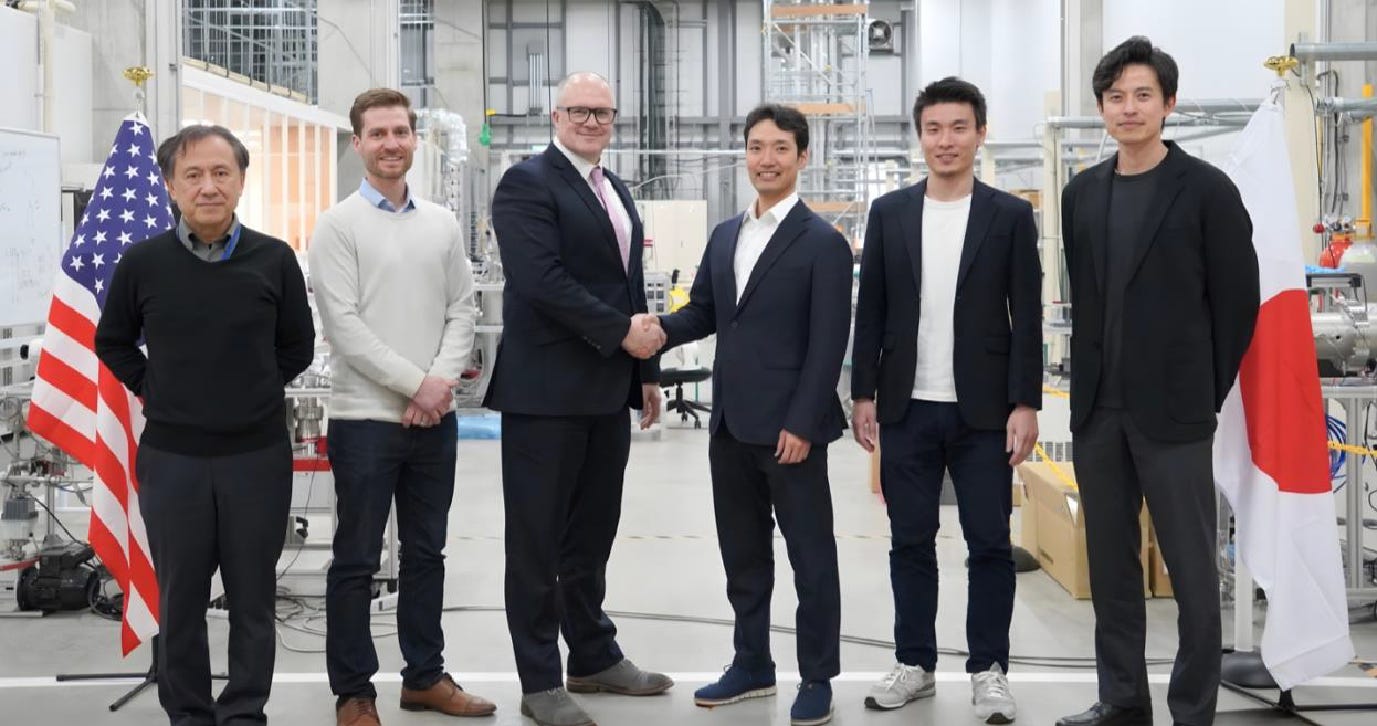
Realta Fusion/Kyoto Fusioneering: Keishi Sakamoto (KF); Dominick Bindl, Kieran Furlong (Realta); Kiyoshi Seko (KF), Yuhei Nozoe (Fusion Fuel Cycles); Yuto Yoshioka (KF)
Today, Realta Fusion and Kyoto Fusioneering (KF) announced a bilateral strategic partnership designed to accelerate the global commercialization of fusion energy. KEF, a world leader in integrated fusion engineering systems will bring its expertise to the design, engineering and fabrication of plasma heating systems to the development of Realta’s magnetic mirror fusion machines.
The first phase of this partnership involved the purchase by Realta of gyrotrons, the high-powered microwave generators that help heat fusion plasma to many times the temperature of the Sun from KF. Realta will install these gyrotrons on their first commercial-grade fusion machine. Future collaboration will include joint engagement of their respective governments, stakeholders and regulators, as well as joint supply chain development for components, materials and subsystems.
“Most visibly, this partnership allows Realta to access some of the best fusion engineering expertise in the world at KF and tap directly into the depth of the Japanese supply chain, but it goes much deeper than that,” said Realta Fusion CEO and Co-Founder Kieran Furlong. “We’re building a bridge between the fusion industrial ecosystems of two of the world’s largest economies to get each of us to commercial fusion faster than we ever could on our own.”
“This alliance represents a powerful convergence of American ingenuity in plasma physics and Japanese excellence in precision manufacturing and integrated fusion systems,” said Kiyoshi Seko, KF’s President and COO. “By linking our respective industrial bases, we are not just advancing magnetic mirror technology; we are forging the resilient, cross-border supply chains required to make commercial fusion a reality.”
Realta Fusion, which spun out of a large fusion experiment program at the University of Wisconsin-Madison and was funded by the US Department of Energy (DoE) Advanced Research Project Agency-Energy (ARPA-E), utilizes high temperature superconductor (HTS) magnets in a magnetic mirror configuration. The company recently announced a $36 million Series A funding round, which was led by new investor Future Ventures, with further support from existing venture Khosla Ventures. The alliance with Kyoto Fusioneering, the world’s premier fusion technology integrated systems provider, promises to accelerate Realta’s development of their magnetic mirror approach by providing other critical technologies and systems necessary to complete the project. Kyoto Fusioneering has raised over $120 million to date to fund their development of critical components required for the commercialization of fusion energy.
Interview With Realta Fusion CEO Kieran Furlong
Last Friday, The Fusion Report (TFR) sat down with Kieran Furlong, CEO of Realta Fusion to discuss their recent progress on their magnetic mirror fusion device, and their strategic partnership announcement with the Kyoto Fusioneering.
TFR: You are focused on fusion utilizing magnetic mirrors. What advantages does this approach have versus competing approaches, whether MCF or ICF?
Kieran: Great question. Well, NIF’s achievement in December of 2022 was an important milestone, it was not on a production system. The magnetic mirror approach has a lot of advantages over ICF approaches, or other MCF approaches like tokamaks. One of the biggest advantages is geometry - our magnetic mirror is not donut-shaped. This enables both a range of sizes and configurations of our device that tokamaks cannot achieve.
TFR: Given that, the magnetic mirror seems like it would be natural for applications such as seaborne transportation, or perhaps even space transportation.
Kieran: Absolutely. Seaborne transportation, whether it be surface ships or submarines, is a great application for magnetic mirrors with its variability in shapes and in power profiles. As far as space transportation goes, let’s first get fusion working on the Earth’s surface before we worry about putting it in space; that has lots of additional challenges.
TFR: How do you plan to approach the potential issues of having teams from the United States and teams from Japan working together, whether they be time zones or differences in engineering approaches?
Kieran: We see this as a critical advantage, where teams with different capabilities and types of expertise come together to produce a result. While there is almost an obsession with vertical integration in the VC and high-tech markets, it’s not something that most companies in our space can really afford, nor is it necessarily realistic.
TFR: How critical do you see Kyoto Fusioneering’s help in accelerating your progress?
Kieran: That is the whole reason that we are entering this partnership. They have some great capabilities around several technologies, such as thermal blankets and the generation of tritium as part of the overall fuel cycle. By spreading out the work and the risks to apply a variety of expertise across our extended team, we believe we will significantly speed up our progress on fusion.
TFR: When do you see our industry being able to put commercial electrical power on the grid from fusion energy?
Kieran: I would look at it a little differently. There are several different aspects of fusion that could be valuable to industry, including as a heat source or behind the meter, as well as power on the grid. The grid is a big beast that doesn’t necessarily move fast, and for good reason. There are a lot of other applications, whether behind the meter for data centers, heat sources for industrial applications, or seaborne transportation power sources that potentially can move a lot faster than putting power on the grid. As far as “where” is concerned, there are a lot of advantages of engaging in markets in Eastern Asia like Japan or Singapore. In these markets, power costs are significantly higher than in the US, and these markets are highly dependent on imported power like oil or liquified natural gas. Fusion energy is an especially good alternative for these markets.
What All of This Means to The Future Fusion Energy
As was once said in a number of movies, “You go with what you know”. That not only applies to the selected approach fusion, whether it be helical stellarators in the case of Helical Fusion, or magnetic mirrors in the case of Realta Fusion, but also where partnerships are involved to provide other pieces of the puzzle, such as done by Kyoto Fusioneering. The development and commercialization of new technologies such as fusion energy involves massive capital, and a diverse set of capabilities that few companies have mastered alone. As we have stated previously, even Commonwealth Fusion Systems (CFS), which has received nearly $3 billion in funds since their start, is dwarfed by the $10.5B that Rivian (an electric vehicle car/truck company) has raised prior to their IPO.
As we’ve said before, fusion is a lot harder than rocket science, let alone the manufacturing of electric vehicles (EVs, not to knock Rivian’s cars and trucks, which are very nice). Rather, this shows why it is important that a number of different approaches to fusion energy are being tried by different companies, and that companies such as Kyoto Fusioneering can lend their capabilities and expertise in critical supporting technologies to the development of those fusion approaches. The development of ecosystems, whether in fusion or other areas, generally speeds up the development of the technologies as multiple companies master different areas, and more importantly, spread out the risks. That is more important in the commercialization of fusion energy than almost any other factors, whether from a scientific or engineering perspective.