

Mining the Moon for Fusion
Lots of good ingredients and companies who want to get them, but how realistic and economical is it?

A quick update to Tuesday’s story on ”How Much Funding has Fusion Received”: SHINE Fusion just announced today that it raised $240 million in new funding, for a total of $1.04 billion. This eclipses Pacific Fusion at $900 million and just passes Helion at $1.037 billion. Additionally, Proxima Fusion has just announced a memorandum of understanding to fund a €2B fusion power plant in Bavaria, though funding has to be finalized. You can read the updated story here.
Most everyone loves the concept of mining space. From conceptual illustrations sixty years ago when we were first starting to explore space, to shows like The Expanse or Dune (both versions, though Denis Villeneuve’s is more watchable), which take a dystopian view of it (at least initially), man has always imagined mining space for its resources. And for those of us who love science fiction, who wouldn’t like the idea? So with that in mind, The Fusion Report explores the potential (and the challenges) of mining the moon (our closest neighbor), in this case for the benefit of fusion energy.
What Are The Initial Approaches of Moon Mining Likely to Look Like?
In the early stages of lunar mining, operations would likely focus on small, robotic missions designed to map and test resource-rich areas rather than large-scale excavation. Autonomous rovers would begin by analyzing the Moon’s regolith (surface dust and rock) for key materials. These robots, powered by solar arrays or compact nuclear reactors, would drill shallow cores, collect samples, and send data back to Earth to determine the most promising sites for future expansion.
Once resource zones are identified—particularly at the Moon’s polar regions where water ice is believed to be abundant—the second wave of operations would involve building small processing stations. Water ice is arguably one of the most exploitable resource for early Moon mining since it can be split into hydrogen and oxygen for rocket fuel and breathable air; otherwise, it is necessary to bring rocket fuel to the moon before flying ‘cargo’ back to Earth.
Mining Helium-3 on The Moon
For fusion, helium‑3 (He-3) is one of the most valuable prizes of early lunar mining because it can be exploited in aneutronic fusion reactors. While it is extremely rare on Earth (found in trace amounts, mainly from nuclear stockpiles), the first few meters of the Moon’s regolith contains a vast, accessible supply of He-3 estimated at over 1 million tons, generated by the Sun and implanted over billions of years by solar winds. Once extracted, He‑3 would be stored as a compressed gas or liquefied in high‑pressure, super‑insulated tanks. Even a few hundred kilograms of He-3 would be valuable cargo compared with its mass; prices today hover at around $20M per kg. From there, the compressed He-3 would be carried back to Earth via specialized reentry vehicles which would deliver it to ground facilities and eventually to fusion machines.
While He-3 exists on the Moon in large amounts, it sits implanted in the lunar soil in parts per billion concentrations. That means mining it needs large, mobile systems that constantly scoop, sift, and process vast areas of surface material while using as little power as possible (think Dune’s harvesters mining for the spice melange).

Concept designs typically use electric excavators or rovers to ingest regolith, then heat it to roughly 700–900 °C in sealed chambers so that the He-3 (along with other trapped gases) can be collected. The hot gas mixture would then be run through cryogenic or pressure-swing adsorption systems to separate and concentrate the He-3.
Is Anyone Currently Working on Plans to Mine the Moon for He-3?
With NASA planning on launching an Artemis II rocket around the Moon as early as March of this year, is it too early to start talking about plans to mine the Moon? Several companies and partnerships are actively developing plans to mine the moon for He-3, with Seattle-based Interlune, Japan’s ispace, and Black Moon Energy leading commercial efforts to extract He-3 and return it to Earth. In particular, Black Moon Energy is planning on scouting and securing the Moon by 2029 to prepare for helium-3 production to support aneutronic fusion, while ispace is planning on supporting moon colonization by 2040. Interlune is also planning to support aneutronic fusion, as well as other uses such as quantum computing, national security needs, and medical imaging.
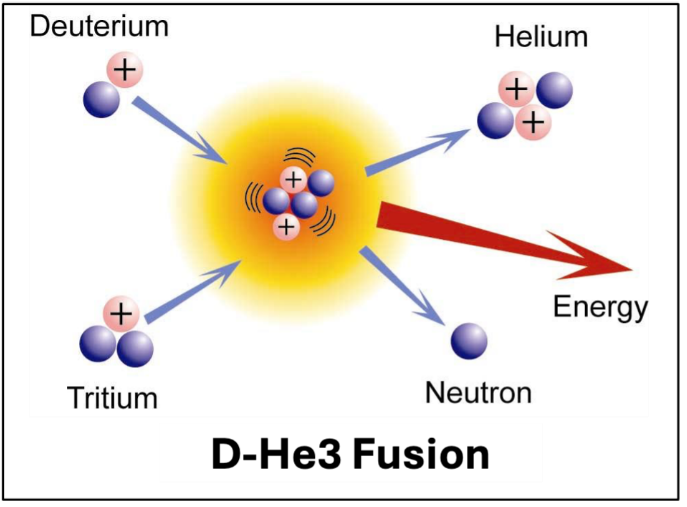
Getting He-3 fuel from the Moon (in combination with deuterium) is not the only challenge to produce aneutronic fusion. While deuterium-tritium (D-T) fusion requires temperatures of approximately 100 M°C to 150 M°C to overcome electrostatic repulsion, D-He3 fusion requires temperatures at least 200 M°C (roughly 50 M°C higher). On the positive side, D-He3 does not produce neutrons (or at relatively few neutrons), which produces a significantly cleaner ignition. More importantly, D-He3 fusion primarily carries away its energy in terms of charged particles, which can be used to directly produce electricity.
Going to The Moon is Only Part of the Problem (But an Important Part)
Getting abundant He-3 is important for aneutronic fusion, and the moon is the closest source of it. There are a number of companies working to get to the moon and extract it, typically utilizing existing space vehicles; from a timing perspective, they appear to be aligned with timeline for D-He3 fusion. Another example of the fusion supply chain (and entrepreneurs) rising to meet the opportunities available from fusion energy.