

ARPA-E Innovations Summit 2026 Highlights
Fission and Fusion (and Batteries) Share the Spotlight

The Fusion Report has covered the Department of Energy (DoE) ARPA-E Innovation Summit for four years in a row, starting in 2023. The first three of these that we covered were at the Gaylord Convention Center in National Harbor, Maryland (just outside of Washington, DC). This year however it was at the Gaylord Convention Center in San Diego, California, which meant that I could attend without having to fly (GREAT!). It looks like this is going to be a trend, since next year it is going to be held in Orlando, Florida, but I digress.
The biggest change over the past two years has obviously been the effect of President Trump’s change in energy policies, which has moved away from renewables (especially wind power, though solar has been surprisingly resilient), and towards ’baseload’ power sources (fossil fuels, geothermal, and nuclear fission) which are dispatchable. When combined with the rapid increases in US power consumption (not to mention the impacts of the recent Iran conflict on the availability of Gulf oil, which are still rippling through the world economy, and will likely cause long-term global energy changes), the world energy picture has rapidly changed, to say the least. With that background, here are some of the highlights from the 2026 ARPA-E Energy Innovation Summit.

Secretary Chris Wright’s Keynote Address
DoE Secretary Chris Wright wound up Day 1 of the ARPA-E Innovation Summit with a 10-minute keynote followed by roughly half hour fireside chat with AMD CEO and Chairman Lisa Hsu. Some highlights of the speech and fireside chat included:
We must treat climate change in the right context. We can’t forget it, but it must be balanced against our need for massively more energy. Energy enables us to make human lives better.
We need to think about where data center efficiency is going, and why? Essentially, Moore’s law has been replaced by the need to increase energy efficiency. We are at an inflection point. We need to optimize every ounce of energy used in data centers, and we need to get them more power to enable AI.
We need to innovate faster, especially making the electricity sector more responsive and cheaper. While other energy sectors became cheaper and more plentiful, electricity has become more expensive.
Government needs to move as fast as private industry to effectively work together. The Genesis supercomputer mission is an example of what can be done in that respect: it only took nine months to build two new supercomputers and place them in DoE labs.
We have a compute shortage today – there are a lot of HUGE problems that we cannot solve. Fusion is just one example; think about drug discoveries or improving the grid with AI. For humans, AI can give us back time to make new discoveries.
The DoE message on commercial fusion energy (and the overall Trump administration message for that matter), was mixed at best. While the DoE ARPA-E office just committed $135 million to accelerate the development of fusion energy technologies, it also cut the DoE’s fusion science initiative $805M to $755M, according to the Fusion Industry Association. In contrast, China is reported to be spending an estimated $1.5B annually on fusion, roughly twice that the US is spending annually. Even the UK is now approaching the annual US funding rate for fusion energy, spending $660M annually on fusion.
In a sense, this situation reflects internal conflicts regarding fusion energy versus fission energy within the Trump administration, which has recently plugged in $1.5 billion for the DoE’s Office of Nuclear (Fission) Energy. This is in part due to the fact that nuclear fission is a known quantity when it comes to energy production, while fusion isn’t. Given the Trump administration’s short-term focus regarding energy production, this prioritization of commercial nuclear fission over developing production fusion energy is not a surprise.
Nuclear Fission: 4X the Output in 2050
The actual title of the session was “4X by 2050: Reimagining Nuclear”. The name of this session came from President Trump’s aim to increase U.S. nuclear energy capacity from 100 gigawatts to 400 gigawatts by 2050 (4X).

The session was an hour of great discussions from a panel of people either in or adjacent to the nuclear fission industry. Some highlights from this session include:
The panel stated that there will be 5 GWe of new reactors in the US by 2030. That is on top of the current 54 operating nuclear power plants in the US with a total of 94 reactors, and an output of 97 GWe (20% of US power).
France (#2 in nuclear fission energy) has 57 operational nuclear reactors, with an output of 63 GWe (roughly 70% of its electricity consumption). Interestingly. France standardized its reactor fleet on a single reactor design, speeding deployment considerably.
China (#3 in nuclear fission energy capacity) now has 60GWe of nuclear power, produced by roughly 60 reactors. This is expected to grow to 200 GWe by 2040, accounting for 10% of China’s total electricity consumption. This would certainly surpass France (who China arguably has caught up with), and might even surpass the United States if we don’t at least double the US nuclear fission capacity in the same timeframe.
In the US, the Westinghouse AP1000 reactor is the most recent ‘large’ reactor to be deployed, with a power output of 1.1 GWe. It is a Generation III+ pressurized water reactor (PWR), with a passive safety system. The Vogtle nuclear power plant in Georgia uses four of the AP1000 reactors.
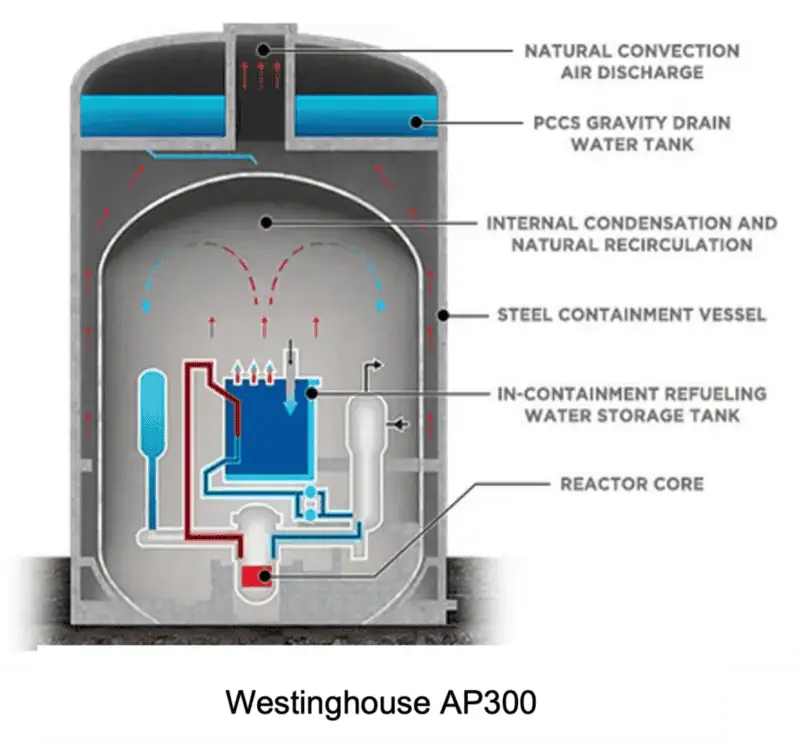
There are several small modular reactors (SMRs) in the US under development. The Westinghouse AP300 is a ‘little brother’ of the AP1000, outputting 300 MWe of power. The X•Energy XE-100 is another SMR with 80 Mwe, but uses a helium gas coolant, and TRISO-X high-assay low-enriched uranium (HALEU) fuel chips. Notably, Amazon recently announced a major investment in X Energy, hankering a $500 million funding round to support the needs of Amazon data centers.
The most interesting part is the language on reactor testing protocols for next-generation reactors. It says that “within 90 days of the date of this order, the Secretary shall take appropriate action to revise the regulations, guidance, and procedures and practices of the Department, the National Laboratories, and any other entity under the Department’s jurisdiction to significantly expedite the review, approval, and deployment of advanced reactors under the Department’s jurisdiction. The Secretary shall ensure that the Department’s expedited procedures enable qualified test reactors to be safely operational at Department-owned or Department-controlled facilities within 2 years following the submission of a substantially complete application”. At least it speeds up the nuclear fission testing process.
Key Fusion Announcements at ARPA-E Summit: Not Many
Beyond the above, there was remarkably little new policy announcements regarding fusion at the 2026 ARPA-E Innovation Summit. That said, ARPE is not called “The Fusion Summit”; it’s called the (Energy) Innovation Summit. And it is for all energy policy, not just fusion. In any case, government funding of commercial fusion energy in itself is not the right answer. The real question is: what is the best way to support US energy needs, including (but not limited to) commercial fission and fusion. Given the US economy’s need for electricity, it certainly appears that we need more sooner than later.